
Bilingual Kita, English-speaking kindergarten, international preschool: the labels sound alike, but they describe very different approaches to language, daily routines and school culture.
When families evaluate early childhood options in the Frankfurt and Taunus region, whether moving from abroad or living locally in towns like Oberursel, Bad Homburg, Kronberg or Frankfurt, they meet a wide range of terminology. Labels such as bilingual Kita, English-speaking kindergarten or international preschool are often used interchangeably, yet they represent fundamentally different approaches to language, daily routines and school culture.
Choosing the right environment during the formative years between the ages of 1 and 6 is one of the most important decisions parents make. Beyond campus facilities and opening hours, the key starting point for most families comes down to language structure: should you choose a strict 50/50 bilingual split or a primary English immersion model?
The language spectrum: 50/50 bilingual vs. full English immersion
Understanding how languages are lived day to day helps parents match a school's framework to their family's goals.
1. The 50/50 bilingual model
In a classic bilingual kindergarten, two languages, typically German and English, are split evenly throughout the week or divided using the "One Person, One Language" (OPOL) approach.
- Who it suits best: families for whom both languages carry equal weight right away, often because their long-term plan is a direct transition into a German state primary school.
- The consideration: for international children who arrive speaking neither German nor English, processing two brand-new languages at the same time can create unnecessary cognitive friction during their transition phase.
2. The English immersion model ("the language bath")
In an English immersion setting, English is the primary, living medium of the classroom day. Children acquire vocabulary and grammar in context, during morning circle, spontaneous play, practical life exercises and shared lunch, absorbing language naturally in the same way they learned their first words.
- Who it suits best:
- Expat families: mobile international families who need a global language foundation that ensures seamless educational continuity wherever life takes them next.
- German families: local families who want their children to use early neuroplasticity to gain fluent English naturally. Because German is spoken at home and in the surrounding community, children keep their native language while picking up a second one with ease.
The TIMS model: a global English foundation with authentic host-country roots
At TIMS (Taunus International Montessori School e.V.), we do not follow a rigid 50/50 split. Instead, we offer a primary English immersion environment, thoughtfully combined with deliberate German language integration and cultural anchoring.
Our community brings together more than 20 nationalities. English is the natural bridge that unites everyone, without overwhelming children who start with no English.
Our language setup rests on three balanced pillars:
- Primary English immersion for natural global fluency: led by native English-speaking educators, daily classroom life, stories, library time and morning circles happen in English, letting children absorb listening, speaking and early literacy skills at their own pace. Explore our curriculum.
- Integrated German lessons and native German staff: living in Germany means feeling connected to your host country. TIMS includes dedicated German sessions with our German language specialist three days a week, a German morning circle, and an optional afternoon German Book Club (see our afterschool activities).
- Celebrating German culture alongside global traditions: we root our international community in local heritage. Children experience traditional local events like St. Martin lantern walks (Laternenumzug) and Fasching right alongside international cultural celebrations, giving them a sense of home in Hessen.
The Montessori difference: how self-directed, mixed-age learning accelerates language
What sets TIMS apart from other preschools in the Taunus area is how our educational philosophy supports language learning. In a Montessori environment, children do not sit through passive language lessons; they acquire language through action, practical life and social connection.
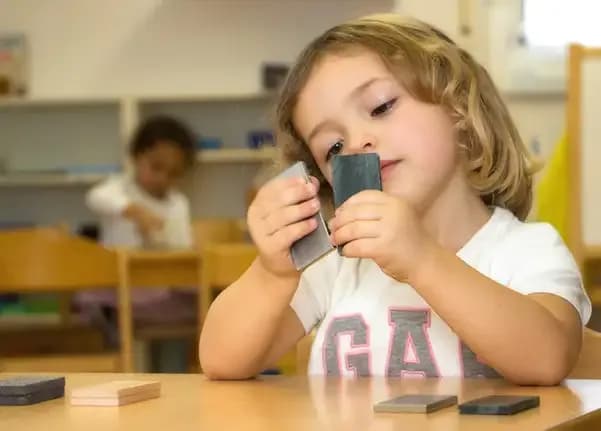
- Child-led exploration: guided by long-serving, family-like educators, children move through uninterrupted work cycles in which they choose hands-on sensory, mathematical and practical life materials. Language is naturally tied to physical objects and real-life tasks.
- Mixed-age groups (ages 3 to 6): in our kindergarten groups, younger children absorb vocabulary by watching older classmates, while older children build confidence, responsibility and communication skills by mentoring their younger peers.
- A safe, family-like atmosphere: small groups and a nurturing environment mean that children new to English never feel pressured to speak before they are ready. Individual guidance from their teachers helps them build genuine confidence day by day through hands-on learning and natural interaction.
Conclusion: experience the TIMS community first-hand
Choosing between a bilingual and an English immersion preschool is about finding the environment where your child feels secure, curious and inspired to grow. TIMS offers international openness, strong German roots and a proven Montessori foundation, all within a warm, family-like school community in the heart of Oberursel.
We invite local and international parents to visit our kindergarten, see our prepared classrooms, explore our green garden spaces and experience the TIMS difference in person. You can also learn more about our international community, our location and our fees.